

Ukraine's "Spider's Web" Operation: How Disguised Mobile Launchers Broke Russian Airbase Defenses
Saturday — Tactics · DefenseHub · May 16, 2026
DefenseHub · Saturday — Tactics · May 16, 2026
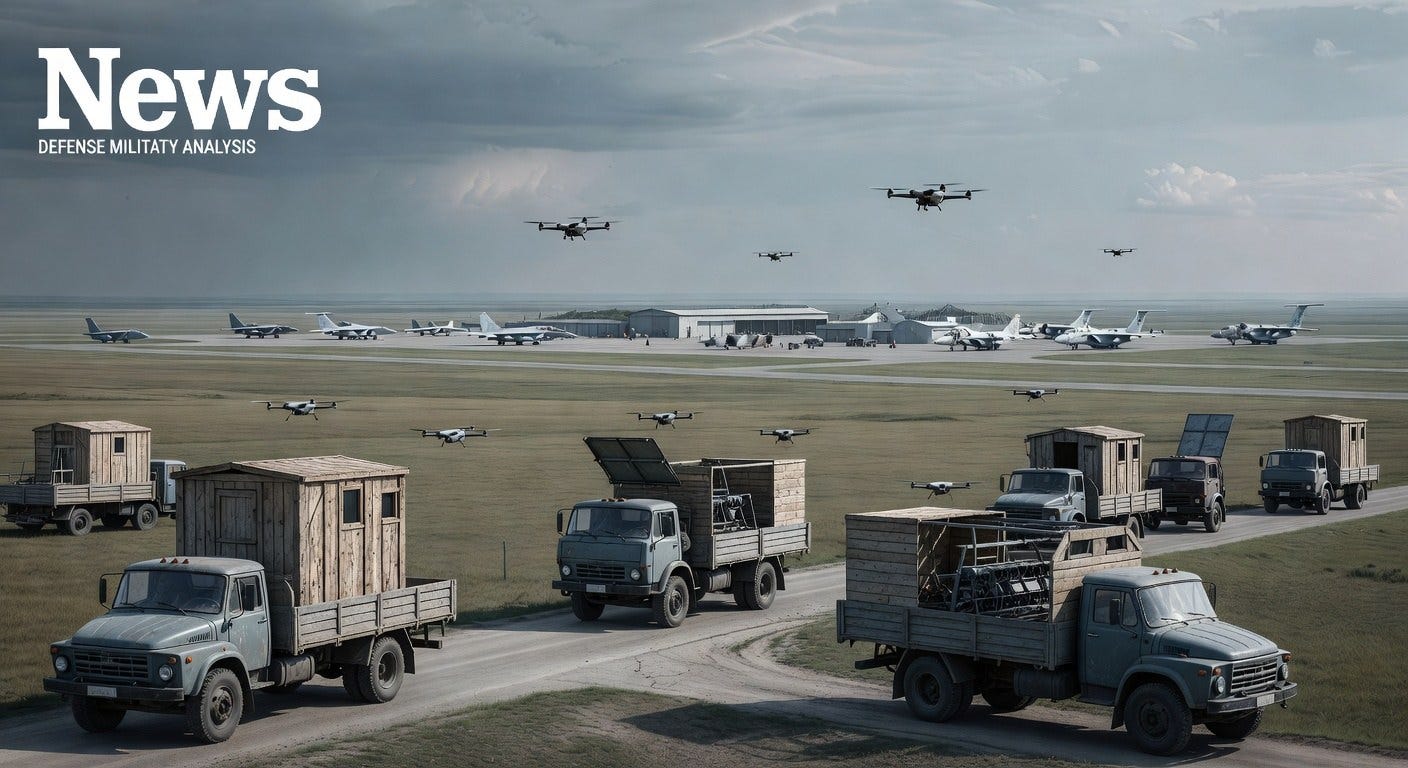
In May 2025, Ukraine executed a coordinated long-range drone strike against Russian military airfields using a concealment method that has received almost no serious tactical analysis: FPV (first-person view) drones launched from wooden cabins mounted on civilian trucks, which then self-destructed to deny forensic recovery. The operation reportedly damaged or destroyed multiple aircraft on the ground at bases deep inside Russian territory. The method matters as much as the result.
What We Know
According to CSIS analysis published after the operation, Ukrainian forces concealed drone launch platforms inside wooden structures mounted on standard trucks, which were then positioned or driven within effective range of target airbases. After launch, the trucks were destroyed, most likely through embedded explosive charges, preventing Russian forces from examining the launcher design, drone guidance hardware, or communications architecture. Confidence level: medium. The operational account comes primarily from Ukrainian and Western open-source analysis, not independently verified by neutral third parties. The self-destruction element is not incidental. It mirrors a pattern already observed with Ukrainian long-range drones, several of which are reportedly designed to detonate after a set flight time to prevent capture and reverse engineering. Applied here to the ground-based launch platform, the tactic extends the same denial logic to the entire kill chain, not just the munition. CSIS describes this as a deliberate denial of forensic access, and that framing holds up under scrutiny. The FPV drones used in the operation are commercially derived systems, typically quadrotor or fixed-wing platforms modified with warheads and sometimes with signal-hardened or autonomous guidance packages. Ukraine has been scaling FPV production domestically through a dispersed, small-unit industrial model. Ukrainian officials have publicly claimed production in the hundreds of thousands of units annually, though independent verification of that figure is difficult. The range and payload specifics of the drones used in Spider's Web have not been publicly confirmed. Russian air defenses at the targeted bases reportedly failed to intercept the incoming systems. This is consistent with a well-documented vulnerability: conventional surface-to-air missile systems optimized for fixed-wing aircraft and ballistic threats struggle against low-observable, low-altitude, slow-moving small UAS (unmanned aerial systems) with minimal radar cross-sections.
Operational Context
Spider's Web did not emerge from nowhere. It follows a months-long Ukrainian campaign to reach Russian airfields that sit beyond the effective range of most Ukrainian artillery and many of its Western-supplied missile systems. Prior to this operation, Ukraine had already demonstrated willingness to strike Engel's Air Base in Saratov Oblast using fixed-wing loitering munitions, and had attempted strikes against airbases in Pskov and elsewhere using modified commercial drones. Each of those efforts prompted Russian adjustments: dispersing aircraft, adding helicopter patrols around perimeters, and deploying additional electronic warfare assets. Spider's Web answered those countermeasures by moving the problem. Instead of trying to fly a drone hundreds of kilometers through layered Russian air defenses, Ukraine drove the launch platform to the edge of the threat zone, compressed the flight path, and eliminated the detection window that longer transits provide. This is doctrinally significant. It reflects a deliberate shift from range-maximization to launch-position optimization, a concept closer to special operations infiltration logic than to conventional air attack planning. In the weeks surrounding the operation, ISW and Ukrainian military reporting noted continued Russian pressure along the Zaporizhzhia and Donetsk axes, with Russian forces attempting to consolidate gains near Avdiivka's successor defensive lines. Ukraine's strategic calculus appears to involve trading tactical ground pressure for depth strikes that raise the cost of Russian air operations, particularly those supporting close air support and long-range missile launch sorties.
My Read
The popular framing of Spider's Web as a drone story is incomplete. This is really a logistics and concealment story dressed in drone hardware. Ukraine did not win because its FPV drones are better than Russia's. It won because it found a way to collapse the detection timeline to near zero by disguising a weapons platform as civilian infrastructure and driving it into position. That is a classic special operations principle applied to unmanned systems at scale. Here's what I keep coming back to: the self-destruction protocol is the most underanalyzed element. Russia has invested heavily in capturing and reverse-engineering Western military technology. The Lancet loitering munition program is partly a product of that effort. By denying Moscow physical access to the launch system, Ukraine complicated Russia's ability to study the specific hardware configuration, guidance packages, and communications architecture used in this operation. That has real value, even if the broad outlines of the truck-concealment concept are now visible to Russian analysts and will prompt adaptation. The distinction matters. Knowing that Ukraine used disguised trucks is not the same as knowing how the electronics were integrated, how the launch sequencing worked, or what communications protocols were used. The self-destruction protocol protects the implementation details even when the general concept is exposed. I think the constraint that will determine whether this model scales is human intelligence exposure, not technology. Driving a weaponized truck into range of a Russian airbase requires route planning, safe houses, local knowledge, and some degree of cover from detection. Ukraine's ability to repeat this depends on how well it has compartmented the support network, and whether Russia's Federal Security Service can work backward from the truck debris to identify that network. I could be wrong, and Ukraine may have found methods of minimizing the human footprint that aren't visible in open sources. The real question is what Russia does in response. Hardening airbases against perimeter-adjacent launches means extending the defended zone outward by tens of kilometers, which is expensive and requires ground forces Russia is not deploying to rear areas in large numbers right now.
What to Watch
Russian announcements of expanded security cordons or checkpoint networks around airfields in Saratov, Ryazan, and Engels oblasts would indicate Moscow has assessed the truck-borne launch vector as a persistent threat.
Ukrainian domestic reporting on FPV production contracts or new industrial partnerships would help confirm whether the launch-denial model is being standardized or remains a one-off special operation.
Any Russian state media or Ministry of Defense claim to have recovered intact launcher components would signal a forensic breach and potentially blunt Ukraine's ability to reuse the specific hardware architecture, even if the general concealment concept remains available to both sides.
ISW or OSINT reporting on Russian aircraft dispersal patterns at rear-area bases over the next 30 days would show whether Spider's Web is changing Russian basing posture at operational depth.
Evidence of similar truck-concealed launch platforms appearing in other theaters, particularly in the Middle East or among non-state actors with access to commercial FPV supply chains, would confirm that this tactic has proliferated beyond Ukraine.
Recommended Sources
CSIS (Center for Strategic and International Studies): Published the primary open-source analytical account of Spider's Web; essential for the operational detail behind the concealment and self-destruction protocols.
Institute for the Study of War (ISW): Daily updates on Ukrainian and Russian operational posture; best source for tracking Russian airbase security adjustments and Ukrainian deep-strike campaign continuity. The War Zone (thedrive.com): Consistent, technically accurate reporting on UAS development and Ukrainian drone program evolution; useful for verifying hardware claims against known specifications. Oryx (oryxspioenkop.com): Visual equipment loss tracking with photo documentation; will flag any confirmed Russian aircraft losses at targeted bases and track changes in basing patterns.
RUSI (Royal United Services Institute): Has published detailed work on Ukrainian drone doctrine and electronic warfare; provides the doctrinal framing needed to assess whether Spider's Web represents a repeatable operational concept or a single-use improvisation.
— R. Planche · DefenseHub