

Reevaluating the Unthinkable: Nuclear Winter in the Era of Great Power Competition
U.S. government interest in the catastrophic climatic effects of nuclear war has collapsed since the 1980s, even as new regional and great power conflict scenarios emerge.
Based on research by James Scouras, Lauren Ice, and Megan Proper
The Johns Hopkins University Applied Physics Laboratory · 2024 · Research report
Why It Matters
This report argues that the U.S. national security community is neglecting a critical, catastrophic risk. While nuclear deterrence policy focuses on the direct effects of an exchange, the potential for a 'nuclear winter'-where stratospheric soot from burning cities causes global cooling, crop failure, and famine-remains a scientifically plausible but poorly understood threat. With the return of great power competition and Russian nuclear signaling, this analysis serves as a stark warning that current deterrence calculations may fail to account for the most devastating global consequences, which could impact non-combatant nations and undermine post-conflict stability worldwide.
📸 Illustrative photo
Key Findings
Government interest and research funding for nuclear winter plummeted after the Cold War and have not recovered, shifting from U.S. government agencies in the 1980s to private foundations in the modern era.
Significant scientific uncertainties persist regarding the climatic effects of a nuclear exchange, particularly concerning the amount of soot produced by urban fires and its subsequent lofting into the stratosphere.
Recent studies on a regional India-Pakistan nuclear exchange show conflicting results, with a 2018 Los Alamos study predicting modest, regional impacts while other studies predict devastating global cooling.
The authors find that the nuclear winter debate has been highly politicized since its inception, with uncertain science being used as a weapon by both anti-nuclear activists and those favoring a strong deterrent, leading to policy paralysis.
The report recommends a new, federally funded research program to resolve key scientific uncertainties and urges policymakers to consider nuclear winter's implications for deterrence, strategy, and stability.
A Threat Forgotten and Revived
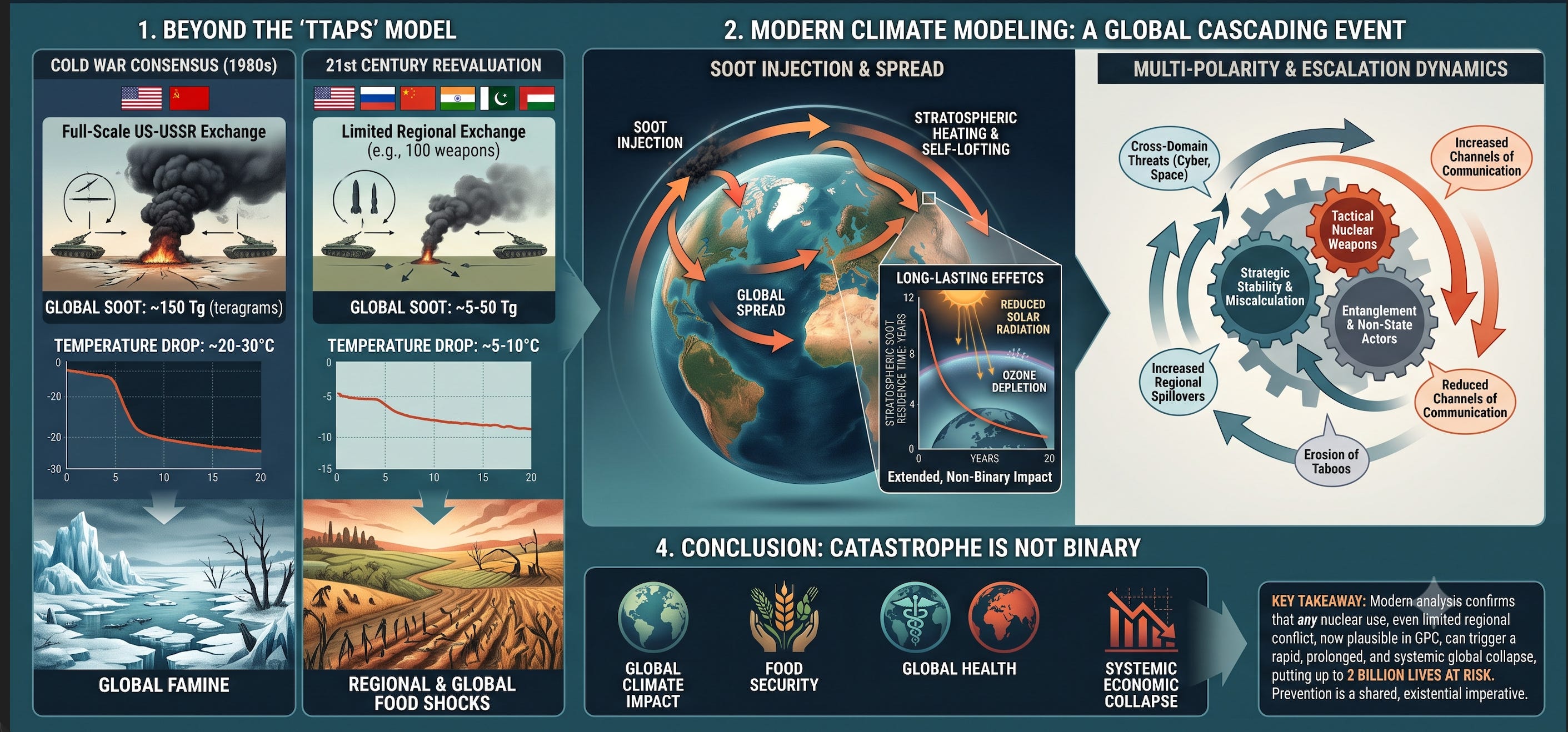
The concept of "nuclear winter" entered the public and scientific debate in 1983 with the seminal "TTAPS" paper, which argued that a large-scale nuclear exchange between the U.S. and Soviet Union would inject enough soot into the stratosphere to cause catastrophic global cooling. According to the APL report, this sparked a flurry of research and intense policy debate throughout the 1980s. However, interest and funding collapsed after the end of the Cold War in 1991.
The report identifies a "nuclear winter revival era" beginning in 2007. This new wave of research shifted focus from a massive superpower exchange to a more limited, regional nuclear war, primarily between India and Pakistan. These studies suggested that even a regional conflict involving around 100 warheads could lead to global climatic disruption, though the predicted severity varied significantly.
Despite a renewed risk of great power competition with Russia and China, the authors note a lack of research on modern conflict scenarios involving these actors. They argue that the focus on regional war, while important, has left a critical gap in understanding the potential outcomes of a peer-level nuclear exchange today.
📸 Consequences of a nuclear winter for the planet
The Unsettled Science
Nuclear winter theory posits a chain of events: nuclear detonations ignite massive urban fires, which produce vast quantities of black carbon (soot). This soot is lofted by pyro-convection into the stratosphere, where it spreads globally, absorbing sunlight and causing a rapid drop in surface temperatures. According to the report, while the basic phenomenology is understood, the magnitude of the effect is highly contested due to major uncertainties at each step.
Key scientific debates center on the amount of fuel in modern cities that would burn, whether fires would create massive, self-sustaining firestorms, the altitude the smoke would reach, and its subsequent lifetime in the stratosphere. These variables are difficult to model and cannot be tested empirically, forcing scientists to rely on complex, and sometimes conflicting, simulations.
This uncertainty is highlighted by a recent scientific disagreement. A 2018 study from Los Alamos National Laboratory predicted only modest and regional climatic effects from an India-Pakistan exchange. In contrast, studies by other research groups using different models predicted a multi-year global cooling event and mass famine from the same scenario. The report states these discrepancies stem primarily from different assumptions about fire dynamics and smoke lofting.
🎥 Castle Bravo Thermonuclear Test - Most powerful device tested by US - 15 Mt
Policy, Politics, and a Path Forward
The authors argue that government interest in nuclear winter waned for several reasons: the diminished perceived threat after the Cold War, the politicization of the science, and the impracticality of proposed policy solutions like total nuclear disarmament. The scientific uncertainty provided a convenient rationale for policymakers to dismiss the issue and avoid difficult questions about deterrence strategy.
This dismissal is now dangerous, the report warns. The return of great power competition, nuclear threats from Russia regarding Ukraine, and China's rapid arsenal expansion have increased the risk of nuclear use. However, the U.S. government has not shown renewed urgency in understanding the potential climatic aftermath. The authors note that the 2021 National Defense Authorization Act mandated a NASEM study on the topic, but this reflects the interest of a few members of Congress rather than a broad, government-wide priority.
The report concludes by recommending a comprehensive, federally funded research program to resolve the key scientific uncertainties. The authors advocate for further policy research on how to balance deterrence with mitigating nuclear winter's effects. They argue that ignoring what could be the most severe consequence of nuclear war is an abdication of responsibility, and that a prudent strategy must plan for the possibility of deterrence failure.
Where the Evidence Is Uncertain
The report highlights major scientific gaps, including a lack of modeling for modern US-China or NATO-Russia conflict scenarios, poor understanding of fuel loads in contemporary cities, the dynamics of urban firestorms, and the precise behavior of soot lofted into the stratosphere.
What to Monitor
Initiation of a federally funded, coordinated research program on nuclear winter effects, as recommended by the authors.
Publication of new nuclear winter studies examining scenarios beyond India-Pakistan, such as a US-China or NATO-Russia conflict.
Statements or reports from the Department of Defense or Department of Energy that explicitly integrate the potential climatic impacts of nuclear war into deterrence policy and strategic planning.
About This Document
"WHATEVER HAPPENED TO NUCLEAR WINTER?" - James Scouras, Lauren Ice, and Megan Proper
The Johns Hopkins University Applied Physics Laboratory · 2024 · Research report
License: Public domain
Selected Sources
This briefing was curated and summarized by DefenseHub from "WHATEVER HAPPENED TO NUCLEAR WINTER?", by James Scouras, Lauren Ice, and Megan Proper, published by The Johns Hopkins University Applied Physics Laboratory in 2024. Findings and underlying research remain attributable to the original authors and publisher.