

North Vector Dynamics Pushes Canadian-Made C-UAS Missile as Drone Threat Demand Accelerates
Wednesday — AI in Defense · DefenseHub · May 13, 2026
DefenseHub · Wednesday — AI in Defense · May 13, 2026
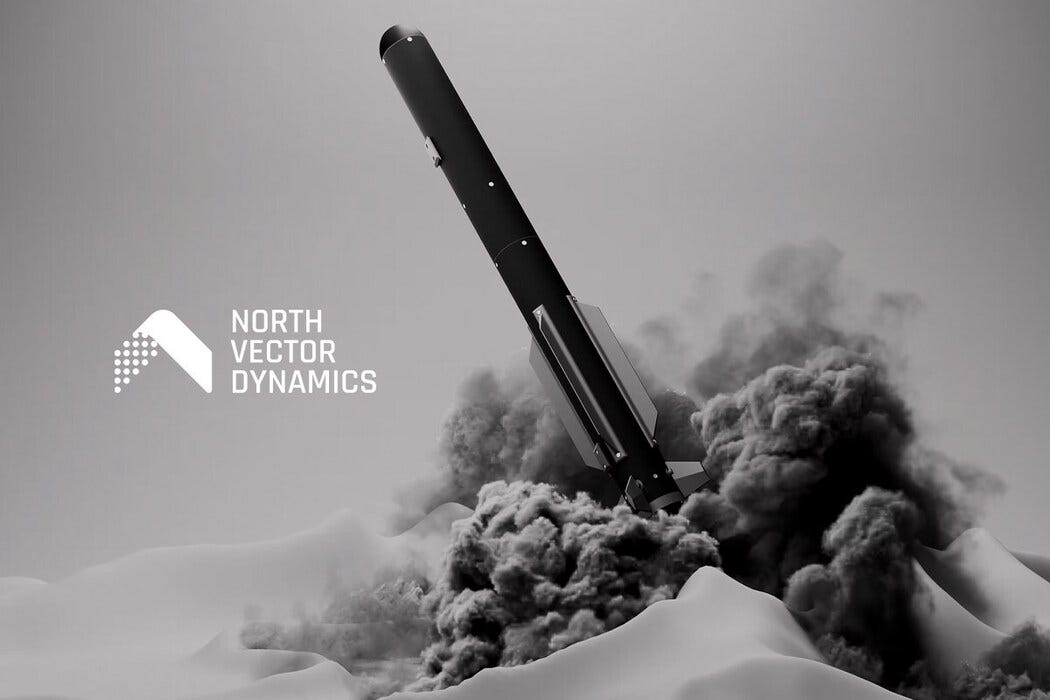
Canadian startup North Vector Dynamics (NVD) is positioning itself to manufacture its CM-70 counter-unmanned aerial system (C-UAS) missile domestically, citing accelerating demand for attritable interceptors. The CM-70 is a 2 kg, semi-active laser homing missile with a stated range of 3.5 km and speed exceeding 1,000 km/h, according to NVD's own website. The company is redirecting focus away from its CI-60 unmanned aircraft system toward the CM-70, per statements by NVD's leadership to Janes.
What We Know
According to Janes reporting from May 6, 2026, NVD describes the CM-70 as an attritable, precision-guided munition measuring 0.72 m in length and weighing approximately 2 kg. The missile uses semi-active laser homing (SALH) guidance. NVD claims artificial intelligence augments the SALH guidance system, though the company has not publicly specified what that AI integration does operationally, whether target classification, terminal guidance correction, or something else. That distinction matters enormously and has not been confirmed by any independent source. Confidence in the performance specifications is low: all figures cited above come from NVD's own website and spokesperson statements, not from independent testing, government certification, or third-party evaluation on record. NVD also produces the CI-60 unmanned aerial system in both target drone and C-UAS configurations, but company leadership told Janes the CM-70 has become the primary focus to meet interceptor demand. No contracts, production volumes, or Canadian government procurement commitments have been publicly announced. It is not confirmed whether NVD has received any certification from Transport Canada, the Canadian Department of National Defence, or a foreign customer.
Operational Context
The timing of NVD's push is not accidental. Defense News reported on May 8, 2026, that Ukraine has sharply expanded ground robot production, and the Pentagon reported on May 7, 2026, that it is actively developing AI-assisted targeting specifically to engage drones. These are not parallel trends. They reflect a single operational reality: low-cost drone saturation has outpaced legacy air defense architecture, and militaries are racing to field cheap, high-volume interceptors rather than expensive legacy surface-to-air missiles. A 2 kg interceptor with a 3.5 km engagement range fits that logic. The mass-attritable concept, fielding many cheap interceptors to defeat many cheap drones, is the same framework driving Raytheon's Coyote Block 3 program and several European equivalents. NVD is entering a real market, not a notional one. Canada's own defense industrial base has faced sustained criticism for slow procurement cycles and limited domestic production capacity. If NVD can establish credible manufacturing on Canadian soil, it addresses a political pressure point that Ottawa has been slow to resolve since NATO allies began openly discussing burden-sharing gaps.
My Read
The AI claim is the part that needs the most scrutiny here. "AI-supported SALH guidance" is doing a lot of work in NVD's marketing language, and it is not backed by any independent verification in the public record. SALH is a mature, well-understood guidance method. Bolting an AI label onto it could mean meaningful target discrimination capability, or it could mean a basic filtering algorithm that smooths the laser return signal. Those are very different things operationally, and no one outside the company currently knows which is true. Here is what I keep coming back to: the CM-70's physical parameters are plausible for the role. Two kilograms, sub-meter length, 3.5 km range, those numbers are in the right neighborhood for a man-portable or vehicle-mounted C-UAS interceptor. The geometry works. What I cannot assess from available sources is seeker sensitivity, warhead lethality against small UAS targets, or the missile's performance in contested electromagnetic environments where laser designation may be degraded. Those are not minor questions. My bet is that NVD's real near-term play is not a large Canadian Forces contract. It is positioning for allied export, specifically to European customers who are under political pressure to diversify supply chains away from American primes and need cheap interceptors at volume. Canada-origin is a useful credential for that pitch, not a capability differentiator in itself. I would not dismiss NVD outright. Small companies with credible form factors have moved fast in this environment. But the distance between a Janes interview and a fielded, combat-tested interceptor is substantial. I could be wrong about the timeline if a NATO customer fast-tracks procurement under emergency acquisition authority, which has happened before. What would change my read: an announced government contract with delivery timelines, independent range testing results, or evidence of integration with a named fire control system.
What to Watch
Watch for any Canadian Department of National Defence procurement announcement referencing NVD or the CM-70, which would confirm the company has cleared at least the threshold of government interest beyond marketing.
Watch whether NVD appears at DSEI 2025 or Eurosatory-equivalent venues with live demonstration data, not renders, as European customer engagement would confirm the export hypothesis.
Watch the Pentagon's formal AI targeting program announcements referenced in the May 7 Defense News report, specifically whether they specify interceptor form-factor requirements that the CM-70's specifications would or would not meet.
Watch for independent C-UAS test data from any government range in Canada, the United States, or the United Kingdom that references semi-active laser homing interceptors in the sub-2-kg class, which would give a baseline against which to evaluate NVD's claims.
Recommended Sources
Janes: Primary trade source on this story; Janes maintains validated equipment databases and is the originating outlet for the NVD reporting.
Defense News: Covered the Pentagon's AI targeting initiative for C-UAS on May 7, 2026, providing direct operational context for the interceptor demand driving NVD's pivot.
The War Zone: Consistent technical depth on C-UAS systems, guidance technologies, and small-UAS threat evolution, useful for benchmarking CM-70 claims against fielded equivalents.
RUSI (Royal United Services Institute): Publishes detailed analysis on drone warfare lessons from Ukraine and C-UAS procurement gaps in NATO member states, directly relevant to NVD's target market.
Breaking Defense: Tracks North American defense industrial base developments and Canadian procurement politics, essential for assessing whether Ottawa is a realistic near-term customer.
— R. Planche · DefenseHub