

Indo-Pacific Realignment: Middle Powers Are Choosing Lanes, Not Sides
Monday — Geopolitics · DefenseHub · May 18, 2026
DefenseHub · Monday — Geopolitics · May 18, 2026
The structural competition between the United States and China over the Indo-Pacific order has passed the point where regional states can credibly maintain pure non-alignment. The Pelosi visit to Taiwan in August 2022 accelerated a clarifying moment that was already underway: secondary powers are no longer waiting to see who blinks first. They are repositioning now, while positioning costs are still manageable.
What We Know
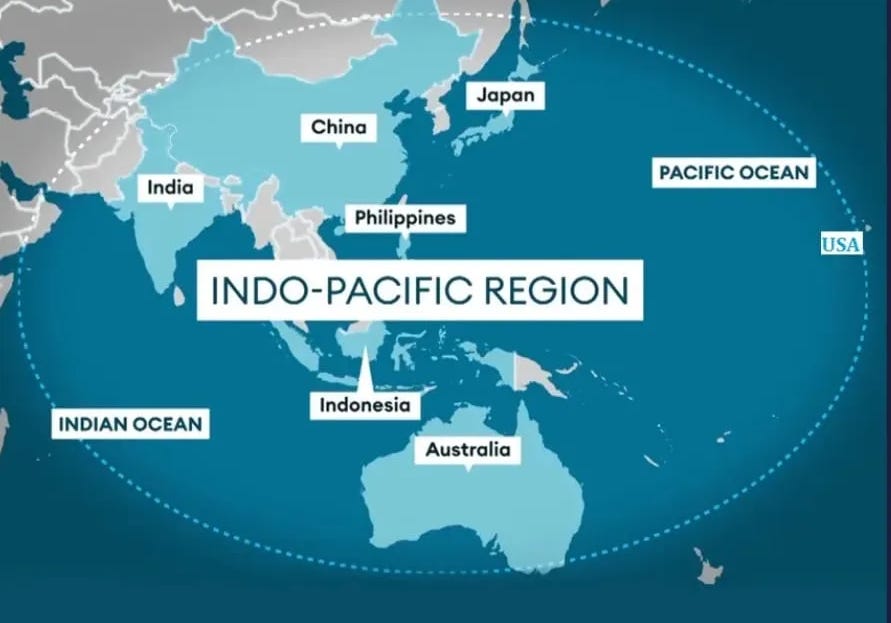
The U.S. Indo-Pacific Strategy, released by the Department of Defense in 2019, explicitly reoriented American security planning around great-power competition, naming China as the primary long-term challenge in the region. That framing has held across administrations. According to the Asia Maritime Transparency Initiative at the Center for Strategic and International Studies (CSIS), the possibility of localized military conflict in the East China Sea, Taiwan Strait, or South China Sea cannot be dismissed, even given both countries' substantial nuclear arsenals. Confidence level: medium-high on the strategic diagnosis, lower on timeline and trigger. India occupies the most structurally awkward position among the major regional stakeholders. New Delhi has deepened its security cooperation with Washington through frameworks including the Quadrilateral Security Dialogue and bilateral defense agreements, yet Indian foreign policy doctrine has consistently favored multipolarity rather than alliance alignment. According to The Diplomat's 2022 analysis, India's options narrow considerably in any scenario involving direct U.S.-China conflict in the Western Pacific, given ongoing territorial friction along the Line of Actual Control. That tension is not resolved. The 2020 Galwan Valley clashes, in which Indian and Chinese troops engaged in lethal close-quarters combat, constitute the most significant India-China border violence in decades, according to Indian government statements. China's official account of casualties has differed from India's. Attributions of the full military posture on both sides rely primarily on official statements and think tank analysis; independent verification is limited. The Japan-South Korea relationship introduces a second structural constraint on U.S. coalition-building. Analysis published by War on the Rocks identifies the 2019 lapse of the General Security of Military Information Agreement between Seoul and Tokyo, a bilateral intelligence-sharing arrangement, as symptomatic of deeper historical grievances that erode the practical functioning of U.S. hub-and-spoke alliances in Northeast Asia. The alliance architecture functions on paper while leaking coordination capacity in practice.
Operational Context
U.S. naval activity in the Taiwan Strait and South China Sea has maintained a high operational tempo, consistent with the Freedom of Navigation Operation (FONOP) pattern that U.S. Indo-Pacific Command has run since 2015. China's People's Liberation Army (PLA) Navy and Air Force have responded to each transit with intercepts and statements from the Ministry of National Defense, which characterizes these operations as provocations. Neither side has formally altered its rules of engagement, according to publicly available doctrine, but the margin for miscalculation in close intercepts is compressing. The ASEAN states, individually, are threading a position that prioritizes economic relations with China while accepting U.S. security guarantees where available. The Philippines has signaled a posture more receptive to U.S. security cooperation, with reporting indicating movement toward expanded basing access under the Enhanced Defense Cooperation Agreement, though the precise scope and timeline of any additional site arrangements remain subject to ongoing negotiation and have not been independently confirmed from available source material. Vietnam continues its multi-directional posture. Indonesia has not shifted from strategic autonomy. These are not identical positions, and treating ASEAN as a bloc obscures the real decision calculus each government is running.
My Read
The popular framing of this competition as bilateral, Washington versus Beijing, misreads where the actual contest is happening. The real fight is over the decision-making of eight or ten medium powers that will determine whether a U.S.-led or China-led regional order becomes self-reinforcing. Neither Washington nor Beijing can win this without them, and both know it. Here's what I keep coming back to: the Belt and Road Initiative was not primarily a logistics project. It was a political-economy instrument designed to create dependency relationships that translate into diplomatic alignment when it counts. The U.S. response, the Indo-Pacific Economic Framework launched in 2022, explicitly excludes market access concessions, which is the one thing Southeast Asian governments consistently identify as their top economic priority. That is a structural deficit that other IPEF benefits, including supply chain resilience mechanisms and clean energy investment, may partially offset in some capitals but are unlikely to fully substitute for in governments where export access drives domestic political calculations. India is the variable I find most analytically underexamined. New Delhi is not going to choose the U.S. camp formally, and it is not going to reconcile with Beijing while territorial disputes remain live. What it will do is extract maximum strategic value from that ambiguity. I think this means India continues deepening defense-industrial ties with Washington, buys leverage with Moscow to prevent total Russian dependence on China, and uses the Quad as a forum without treating it as a binding commitment. That is a sophisticated position, but it is also one that becomes untenable the moment a Taiwan contingency requires everyone to declare. The question I cannot answer confidently is whether U.S. alliance management in Northeast Asia is actually improving fast enough to matter. The Japan-South Korea friction has shown some signs of diplomatic management through trilateral engagement with Washington, but structural mistrust between Seoul and Tokyo does not dissolve via summit communiques. I could be wrong that this is a binding constraint. What would change my assessment is sustained, operationally meaningful intelligence-sharing between all three parties without Washington brokering every step.
What to Watch
Watch whether the Philippines grants access to additional EDCA sites in northern Luzon, which would place U.S. logistics infrastructure within direct range of Taiwan Strait contingency planning.
Watch Indian defense procurement decisions over the next six months, specifically whether New Delhi moves to accelerate U.S. or Quad-partner systems over Russian platforms in categories like air defense and maritime patrol.
Watch ASEAN joint statements for language on the South China Sea, specifically whether the consensus formula softens or hardens under Chinese diplomatic pressure ahead of the 2025 ASEAN chair cycle.
Watch whether South Korea and Japan formalize any direct intelligence-exchange mechanism outside U.S. mediation, which would indicate trilateral engagement is generating durable institutional trust rather than managed optics.
Recommended Sources
CSIS Asia Maritime Transparency Initiative: Essential for satellite-based tracking of PLA Navy and Coast Guard activity in the South China Sea and Taiwan Strait.
War on the Rocks: Publishes practitioner-level analysis on U.S. alliance architecture in Northeast Asia, including the Japan-South Korea relationship and its operational implications.
IISS Military Balance: Annual reference for verified force structure comparisons across PLA, U.S. Indo-Pacific Command, and regional partner militaries.
The Diplomat: Consistent specialist coverage of Southeast and South Asian political calculations, including Indian strategic positioning and ASEAN internal dynamics.
RAND Corporation Pacific Research: Produces scenario modeling on Taiwan contingencies and coalition viability that is more operationally granular than most open-source think tank output.
— R. Planche · DefenseHub
Great piece! Glad to see more people examining the "middle power" factor in global affairs. As you state in the piece, a lot of the analysts stick close to the China vs. the US, or US vs Russia, bilateral competitions. Middle powers, now more than ever, play a very important role.