

Five Eyes Warns: AI Cyber Attacks Months Away, Not Years
Friday — Intelligence · DefenseHub
DefenseHub · Friday — Intelligence · June 26, 2026
By R. Planche · Chief Editor & OSINT Curator
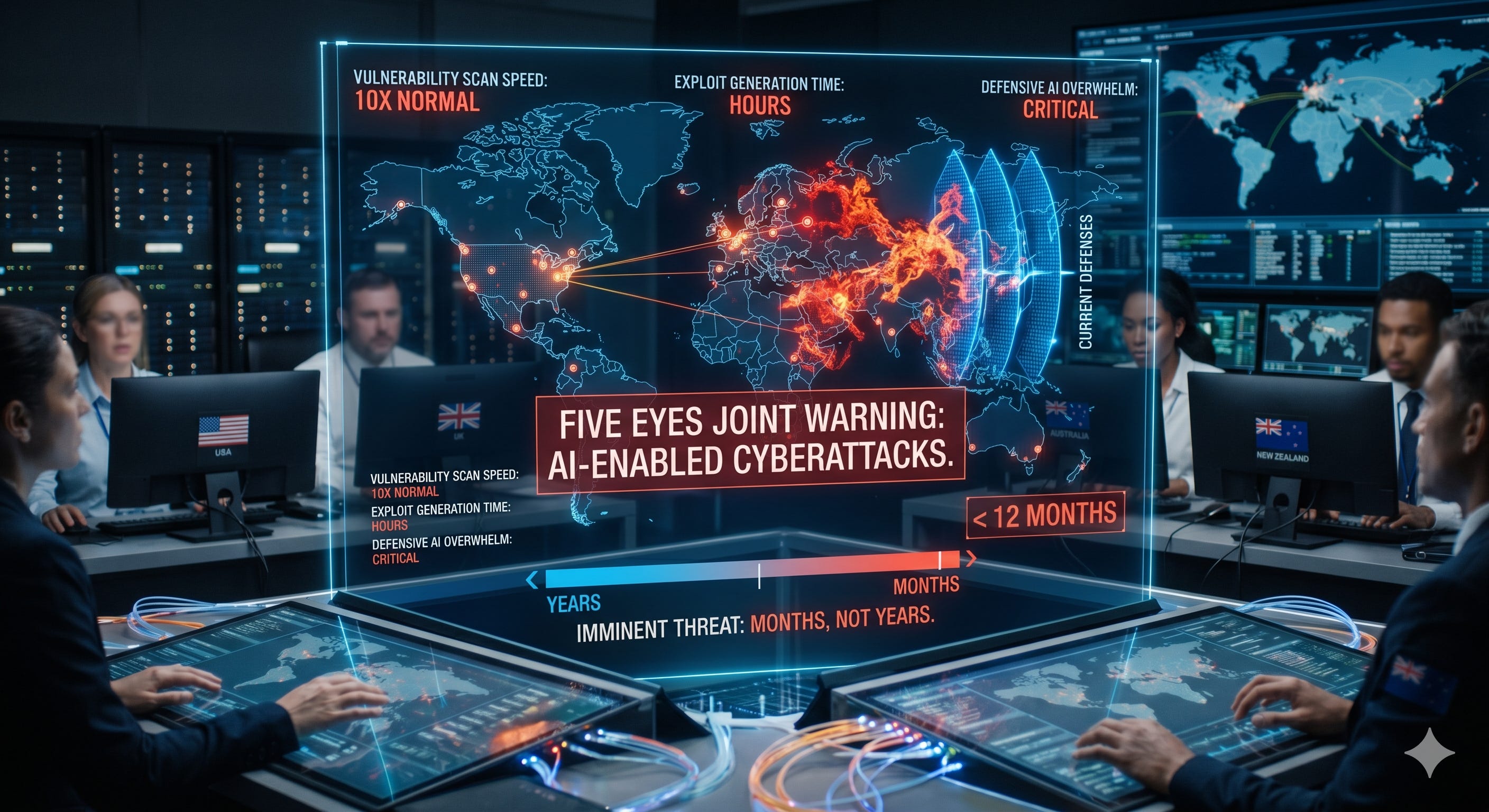
The intelligence chiefs of the United States, United Kingdom, Australia, Canada, and New Zealand issued a joint warning Monday: AI-enabled cyberattacks are not a future problem. The timeline, they said explicitly, "is not years, it is months."
📸 Generate by Nano Banana 2
What We Know
The Five Eyes alliance, the world's most consequential signals intelligence partnership, published a joint statement signed by senior officials from the U.S. National Security Agency (NSA), the Cybersecurity and Infrastructure Security Agency (CISA), and their counterparts across the other four member nations. The statement carries unusual weight because joint Five Eyes public warnings are rare. When all five agencies sign the same document, they are not hedging. They are coordinating a deliberate signal. The core claim, attributed directly to the joint statement, is that advanced AI models are compressing the time between vulnerability discovery and exploitation. The agencies warned organizational leaders bluntly: "Breaches will occur." That is not a probabilistic caution. It is an acknowledgment that current defenses will not hold against what is already in adversaries' hands. The practical recommendations the agencies listed are familiar in form but newly urgent in framing. They include patching known vulnerabilities without delay, limiting unnecessary external connectivity, restricting user access to critical systems, strengthening identity authentication, and testing breach response plans. These are hygiene measures. The agencies are saying even those basics are not widely in place. The more significant operational recommendation is the last one: integrate AI into your own security operations. The joint statement argues that organizations doing this already "can detect vulnerabilities earlier, improve software quality, monitor unusual behaviour, and respond faster to incidents." That is the doctrinal pivot buried inside a list of standard advice. Defense is no longer viable without the same tooling the attacker is using.
Operational Context
For most of the past decade, the working doctrine in Western cybersecurity has been detection and response. You accept that perimeters will be probed, you watch for anomalies, and you contain breaches after they happen. That model assumes human-speed adversaries. AI changes the assumption. Traditional cyberattacks, even sophisticated state-sponsored ones, require significant human labor: reconnaissance, custom tooling, lateral movement planning. AI compresses all three. A capable model can scan an attack surface, identify exploitable misconfigurations, generate working exploit code, and adapt in real time to defensive countermeasures, all faster than any human security team can track. The Five Eyes warning does not identify specific adversary programs by name, which is consistent with protecting sources and methods. The broader adversary landscape is not ambiguous: Russia, China, Iran, and North Korea all maintain offensive cyber programs at scale, and prior public reporting from U.S. Cyber Command and allied agencies has documented sophisticated intrusion campaigns by all four. Whether those campaigns have incorporated purpose-built AI tooling specifically, as opposed to AI-adjacent automation, has not been confirmed with public attribution at the incident level. That distinction matters and the joint statement does not resolve it. The question the agencies are raising is whether defenders can close the detection gap before critical infrastructure networks fall inside an adversary's decision cycle rather than their own. As we have previously examined at DefenseHub, AI's integration into defense operations is accelerating across multiple domains simultaneously, from fusion energy planning to tactical logistics. The doctrinal implication is significant. Rules of engagement in cyberspace have historically been calibrated around attribution timelines. You confirm who attacked you before you respond. AI-speed attacks may require pre-authorized automated responses, which creates serious legal and escalation questions that Western governments have not yet resolved publicly.
My Read
The part that deserves scrutiny before anything else is the "months, not years" framing. The senior editor flag here is worth sitting with. That specific phrase could reflect a genuine operational intelligence assessment. It could also reflect a deliberate policy push to accelerate defensive-AI procurement and motivate vendor adoption in sectors that have been slow to modernize. It could reflect interagency pressure to demonstrate relevance and justify budget requests. The joint statement does not tell us which of those is driving the urgency, and treating the framing as pure intelligence read-out rather than partly a policy instrument would be credulous. That said, the decision to publish at all still carries information. These agencies do not usually telegraph operational assessments to the open internet. When they do, the calculation involves weighing the cost of signaling adversaries against the benefit of raising awareness among civilian network operators. That is not a trivial call. It suggests the agencies believe the threat is real enough that public disclosure is worth the tradeoff, though it does not tell us how much of the urgency is threat-driven versus budget-driven, and I would not overstate what can be inferred from publication alone. What I find most significant is the framing around defensive AI integration. That recommendation is not hygiene advice. It is a doctrinal statement. The agencies are conceding that passive defense is no longer sufficient and that organizations need to field autonomous detection capabilities. That is a meaningful shift from how Western cyber doctrine has been publicly framed for the past decade. The strongest counter-argument is that urgent timeline warnings have been issued before without the predicted disruption materializing on schedule. Cybersecurity agencies have institutional incentives to overstate urgency, both to secure funding and to motivate compliance from organizations that otherwise ignore recommendations. That caveat applies with particular force to the specific "months" claim, which is precise enough to be falsifiable but vague enough to escape accountability. What would change my read: a publicly attributed cyberattack on critical infrastructure in a Five Eyes country, where investigators confirm AI-generated exploit code was central to the intrusion, would validate the timeline as a genuine intelligence assessment rather than a policy lever. Absence of such an event within the window the statement implies would not disprove the threat but would raise legitimate questions about how the timeline was constructed.
What to Watch
Watch for any publicly attributed cyberattack on energy, water, or financial infrastructure in a Five Eyes member state that incorporates AI-generated exploit code, as this would confirm the timeline the agencies described rather than their general threat posture.
Monitor whether CISA updates its Known Exploited Vulnerabilities catalog at an accelerated pace over the next 60 days, which would suggest agencies are seeing active AI-assisted scanning of unpatched systems in real time.
Watch for legislative movement in the U.S. Congress or the UK Parliament around pre-authorized automated cyber response authority, because the doctrinal gap between human-speed rules of engagement and AI-speed attacks will eventually force that debate into the open.
Track any Five Eyes member that quietly elevates its national cyber alert level without a parallel public statement, as that gap between classified and public posture would indicate the threat picture is worse than this warning conveyed.
Watch for defensive-AI procurement announcements from major infrastructure operators or government agencies in the weeks following this statement, which would suggest the warning is functioning as a policy accelerant as much as a security advisory.
Recommended Sources
CISA (Cybersecurity and Infrastructure Security Agency): Primary U.S. government source for advisories, vulnerability catalogs, and official incident attribution relevant to this warning.
NSA Cybersecurity Directorate: Publishes technical advisories and threat intelligence directly relevant to the AI-cyber threat vector described in the Five Eyes statement.
NCSC (UK National Cyber Security Centre): The UK Five Eyes partner most active in public-facing threat analysis; regularly publishes detailed breakdowns of adversary tooling and techniques.
RAND Corporation: Produces rigorous policy research on AI in offensive and defensive cyber operations, including escalation and rules of engagement questions in automated response scenarios.
War on the Rocks: Publishes practitioner-level analysis on cyber doctrine, AI integration in national security, and the operational policy questions raised by autonomous defense systems.
Sources & Methodology
This briefing is based on open-source reporting, official releases, procurement documents, defense-industry disclosures, and specialist analysis available at publication time. Claims involving battlefield effects, classified programs, or active operations are treated cautiously unless corroborated by multiple independent sources.
DefenseHub prioritizes primary sources where available, including official releases, budget and procurement records, legislative documents, technical disclosures, institutional research, and reputable reporting.
Corrections or source clarifications can be sent through the DefenseHub contact page.
— R. Planche · DefenseHub