

Crimea Logistics Lockdown: Ukraine's Drone Surge Explained
Monday — Geopolitics · DefenseHub
DefenseHub · Monday — Geopolitics · June 22, 2026
By R. Planche · Chief Editor & OSINT Curator
Ukraine's Defense Minister Mykhailo Fedorov said on June 17 that a sustained drone campaign against Russian logistics routes could effectively isolate occupied Crimea. The procurement numbers behind that claim are worth examining closely, but so are their limits.
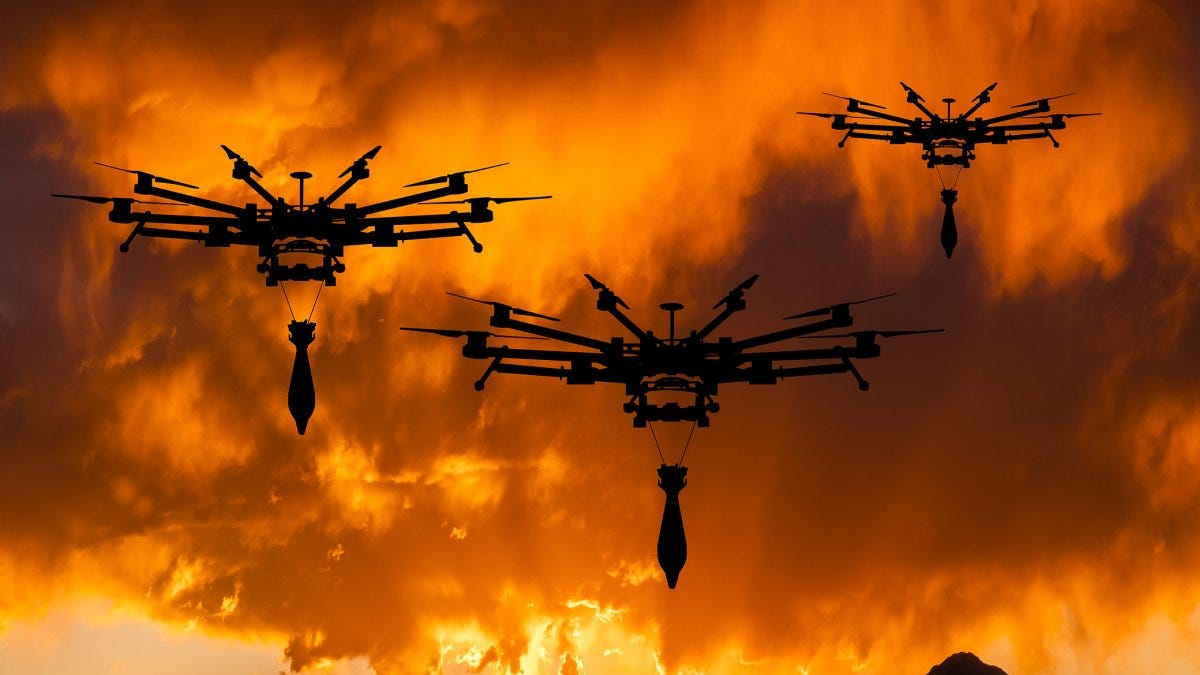
📸 Photo: Anton Petrus/GETTY IMAGES
What We Know
Ukraine's Defense Ministry contracted 300 percent more medium-range strike drones in the first four months of 2026 than during the entire year of 2025, according to an official statement from Fedorov published by The Kyiv Independent. That figure comes from Fedorov's own ministry and has not been independently verified by open-source tracking projects or allied government sources. It should be read as an official Ukrainian government claim, not a confirmed production fact. What medium-range means here matters before stacking any further claims on it. These are drones operating at roughly 100 to 500 kilometers, carrying warheads in the range of 30 to 50 kilograms, designed to hit fixed infrastructure targets such as fuel depots, bridge approach roads, and rail switching yards. That is a fundamentally different mission profile than small first-person-view drones, which weigh a few kilograms, fly a few kilometers, and are used against individual fighting positions or vehicles at the front line. The distinction changes the target set entirely: medium-range platforms are designed for rear logistics interdiction, not frontline attrition. The ministry has also launched what it is calling a "logistics lockdown" program. Under this structure, funding goes directly to military units to purchase and deploy medium-range drones without waiting for slow central procurement cycles. The intent is speed: identify a logistics chokepoint, buy the platform, strike it, repeat. "And this could lead to very unexpected consequences for the Russians. I can't say anything more," Fedorov said, in remarks attributed to him by The Kyiv Independent. That is deliberately vague. But the operational logic is not. Crimea connects to Russian-controlled southern Ukraine through a limited number of land corridors, primarily through the Kherson and Zaporizhzhia oblasts. The Kerch Strait Bridge, already damaged twice in previous Ukrainian strikes, is the peninsula's only fixed crossing to Russia proper. A sustained drone campaign targeting those land routes would compress Russia's logistical options into an increasingly narrow and predictable set of paths. Confidence level on the procurement figures: medium, and only because the claim carries official weight. The 300 percent increase has not been independently confirmed.
Tactical Map
Approximate area of interest: Sustained drone strikes on bridges, railways, and fuel depots aim to sever Crimea's supply lines, creating a logistics lockdown.
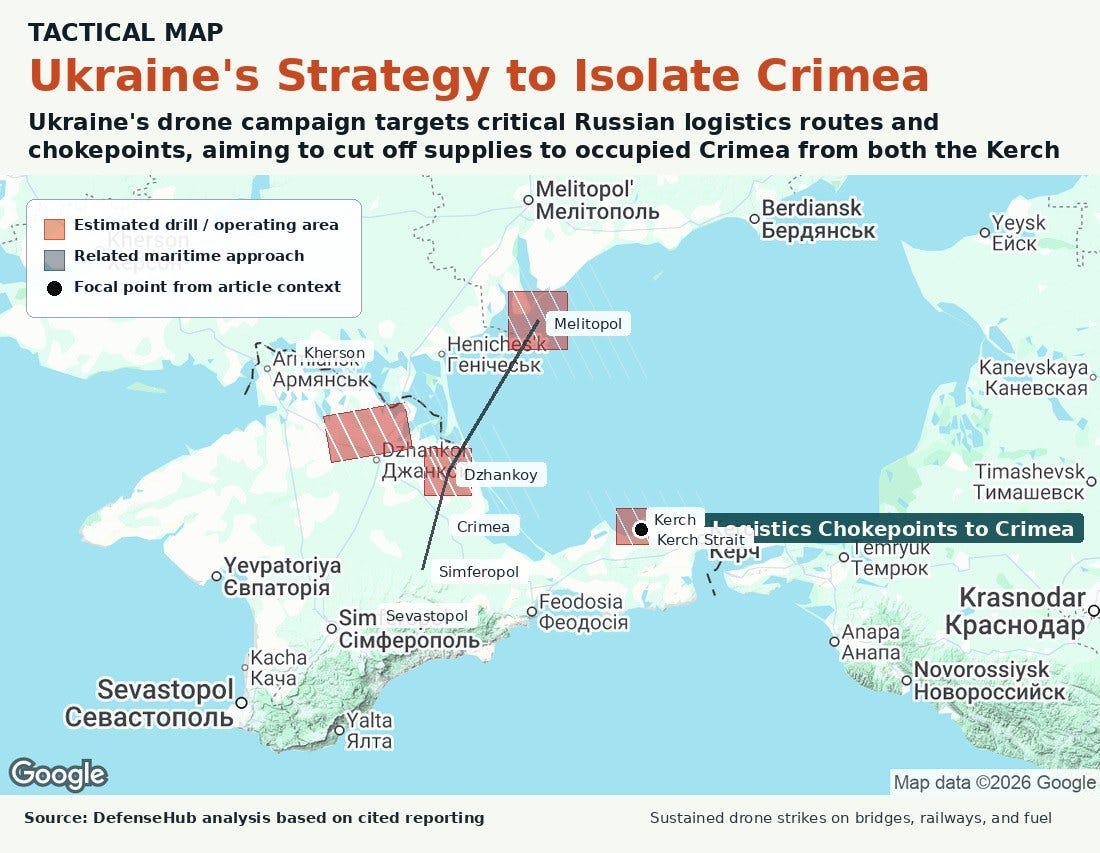
Map is illustrative and intended to orient the operational geography discussed below.
Operational Context
The most direct historical baseline for this campaign is Ukraine's own earlier attempts to pressure Crimea, and the record is uneven. Ukrainian forces struck the Kerch Strait Bridge in October 2022 and again in July 2023, causing significant structural damage both times. Russia repaired the bridge on an accelerated schedule each time and rerouted supplies through the land corridor while repairs proceeded. The bridge strikes demonstrated that Ukraine can hit high-value fixed infrastructure in Crimea, but also that Russia can absorb individual strikes on single nodes and adapt faster than many observers expected. A drone campaign aimed at multiple simultaneous chokepoints in the land corridors would be attempting something more sustained and dispersed than those individual bridge strikes, which is precisely why the procurement volume matters, if it holds. Ukraine's more recent success in the maritime domain provides a second reference point, but one that requires careful handling before applying it to land logistics. Naval Forces spokesperson Dmytro Pletenchuk noted, in the same June 17 reporting, that Ukraine pushed Russian Black Sea Fleet warships back from its coastline and established a working maritime corridor using drone and missile pressure rather than conventional naval force. That campaign worked partly because ships are expensive, visible, and difficult to disperse. Russian naval commanders had strong institutional incentives to move assets rather than absorb attrition. Land logistics does not offer Russia the same clean choice between fight or reposition. Russia has meaningful options for adapting to drone pressure on southern corridors: expanding rail bypass routes through territory further east, shifting supply movements to night convoys with electronic jamming coverage, dispersing fuel and ammunition stockpiles into smaller distributed sites that are harder to locate and less catastrophic to lose individually, and hardening air defense coverage over the most critical chokepoints. The maritime analogy holds in its broad logic, that sustained cost imposition can degrade operational effectiveness without destroying assets outright, but it understates Russia's ability to absorb and reroute on land compared to sea. We explored a closely related development in this newsletter's earlier analysis of Ukraine's laser-designated drone targeting experiments. As we noted in that piece, precision improves the return on every platform deployed, which matters especially when the objective is infrastructure interdiction rather than personnel attrition. The "logistics lockdown" program is effectively the procurement architecture designed to feed that kind of targeting. Why does this matter now? Because Russia's ground logistics in the south have been under pressure for months, and Ukraine is accelerating investment precisely when Russian forces in the Zaporizhzhia and Kherson sectors are already stretched. The timing is not coincidental.
🇷🇺 OSINT Radar — Direct Translation from Rússia:
"Ukraine could isolate Army Group Center by striking south of Berlin during the Soviet advance. This was part of the strategy to defeat Nazi forces with minimal losses. The 1st Ukrainian Front played a key role in this operation...."
My Read
The popular reading of Fedorov's statement is that it is political signaling, a minister talking tough for a domestic audience. That reading is not wrong to be skeptical of the 300 percent figure specifically. The newsletter's own confidence caveat applies: this is an unverified claim from the ministry that would benefit from it. I am not treating the number as confirmed fact. What I am treating as meaningful is that the claim describes a particular kind of commitment, factory contracts, training pipelines, maintenance infrastructure, that would be verifiable or falsifiable within months if independent analysts gain access to production data or satellite imagery of logistics corridor traffic. A procurement expansion that large either shows up in the field or it does not. Here is what I keep coming back to: Crimea is not a politically neutral logistics hub. It is Russia's forward operating base for Black Sea naval power, its air defense anchor in the south, and a symbol of permanence that Moscow has spent a decade reinforcing. Sustained logistical pressure on the peninsula does not just degrade Russian military capability. It creates a political problem inside Russia that a battlefield retreat somewhere on the Donetsk line does not. The skeptical case against the "logistics lockdown" model deserves direct engagement rather than a footnote. Decentralized procurement gives units speed, but it also fragments targeting priorities and diffuses maintenance accountability. Unit-level drone buying without central deconfliction has a documented tendency to produce redundant strikes on the same accessible low-value targets rather than coordinated pressure on the chokepoints that actually matter. If twenty units are each buying medium-range drones and choosing their own targets, the campaign can look active in press releases while failing to hold pressure on any single corridor long enough to force a Russian adaptation crisis. Whether Ukraine has built sufficient central coordination into the "logistics lockdown" structure to avoid that failure mode is genuinely unknown from public reporting. The undercovered risk is on Ukraine's side regardless of coordination quality. Scaling medium-range drone production 300 percent in four months strains component supply chains, maintenance capacity, and trained operator pools. A program that outruns its logistics support can saturate a target list briefly and then fall quiet, giving Russia time to adapt and harden. The industrial gap problem the West faces in drone and munitions production applies, in modified form, to Ukraine too. Speed of procurement without depth of sustainment is a campaign, not a campaign plan. What would change my read: confirmed independent production data, visible reduction in Russian logistics traffic on satellite imagery of the southern corridors, or evidence that the "logistics lockdown" program includes a central targeting coordination layer rather than purely unit-level discretion.
What to Watch
Commercial satellite imagery of the main road and rail routes linking Russian-controlled Zaporizhzhia and Kherson oblasts to Crimea, specifically for signs of reduced vehicle movement, damaged bridges, or diverted convoys.
Russian military logistics behavior around the Kerch Strait crossing, including any increase in air defense deployments or changes in ferry and rail traffic patterns that suggest Moscow is rerouting supply flows.
Ukrainian official announcements of additional "logistics lockdown" funding tranches or any public expansion of the medium-range drone contract list, which would confirm the program is scaling rather than plateauing.
Russian rear-area fire activity and air defense radar activations in occupied southern Ukraine, which OSINT monitoring networks often detect before official strikes are confirmed.
Any statements from Russian-appointed administration officials in Crimea about supply shortfalls, fuel availability, or civilian commodity prices, which historically surface before military logistics failures become visible.
Recommended Sources
Institute for the Study of War (ISW): publishes daily Ukraine campaign assessments with sourced analysis of logistics corridors and Russian rear-area activity, essential for tracking southern front developments.
Oryx: maintains the most rigorous open-source database of confirmed equipment losses in the Ukraine war, useful for cross-referencing Ukrainian procurement claims against documented battlefield attrition.
The War Zone: covers Ukrainian drone procurement and strike campaigns with strong technical detail and sourced procurement reporting.
RUSI (Royal United Services Institute): produces in-depth Ukraine war analysis focused on sustainment, attrition, and industrial capacity, directly relevant to assessing whether Ukraine's drone scaling is durable.
Kyiv Independent: primary source for this story; treat its reporting as official Ukrainian government-adjacent output and weight its claims accordingly, particularly on procurement figures not yet independently verified.
Sources & Methodology
This briefing is based on open-source reporting, official releases, procurement documents, defense-industry disclosures, and specialist analysis available at publication time. Claims involving battlefield effects, classified programs, or active operations are treated cautiously unless corroborated by multiple independent sources.
DefenseHub prioritizes primary sources where available, including official releases, budget and procurement records, legislative documents, technical disclosures, institutional research, and reputable reporting.
Corrections or source clarifications can be sent through the DefenseHub contact page.
— R. Planche · DefenseHub