

China's PLARF Missile Force Evolves: Detection and Interception Challenges
Thursday — Hardware · DefenseHub
DefenseHub · Thursday — Hardware · June 25, 2026
By R. Planche · Chief Editor & OSINT Curator
On June 23, 2026, China's People's Liberation Army Rocket Force (PLARF) publicly demonstrated an upgraded DF-26 intermediate-range ballistic missile and a new DF-17 hypersonic glide vehicle configuration during a Gobi Desert exercise. The headline is not the hardware. It is that Beijing is openly restructuring how, where, and how quickly these weapons can be fired. That claim deserves serious scrutiny before anyone updates their threat assessments on the basis of a single state media broadcast.
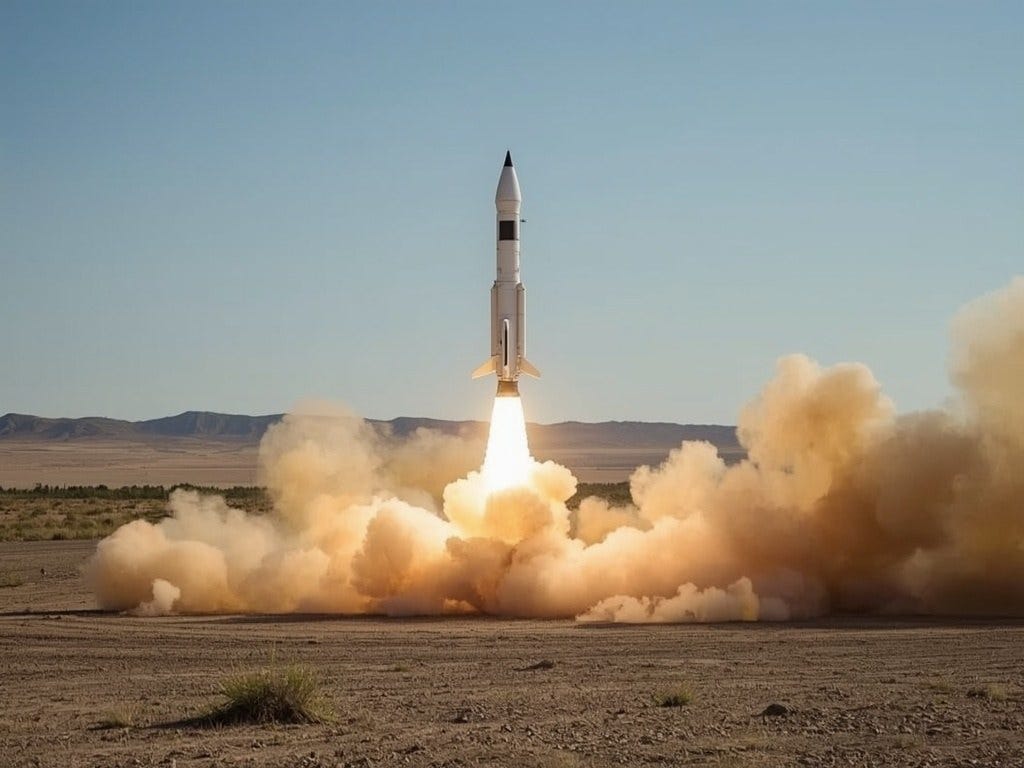
📸 Editorial illustration · Generated by Leonardo.ai
What We Know
According to CCTV, which is Chinese state media and should be treated as an official signal rather than independent reporting, the exercise involved joint participation from the PLARF, PLA Ground Force, and PLA Air Force in China's northwestern Gobi Desert. The report claimed the systems offer improved automation, mobility, precision, and defense-penetration capability. None of these claims has been independently verified. The DF-26 is an intermediate-range ballistic missile. Its range puts Guam within striking distance from Chinese territory. It carries both conventional and nuclear warheads, which creates a deliberate ambiguity problem for any adversary trying to decide whether an incoming missile warrants nuclear retaliation. Readers asking how the upgraded DF-26 differs from the original should focus less on range figures, which remain contested in open sources, and more on the claimed shift in deployment: away from fixed launch sites and toward dispersed field positioning. The DF-17 is a different class of weapon. It delivers a hypersonic glide vehicle, meaning the warhead maneuvers at high speed in the upper atmosphere rather than following a predictable ballistic arc. That makes intercept significantly harder. The U.S. has publicly acknowledged its existing missile defense architecture was not designed to engage this flight profile at scale. Whether the DF-17 can actually defeat existing missile defenses depends on the maturity of its maneuvering algorithms and terminal guidance, neither of which can be assessed from CCTV footage alone. To answer a question many readers will have directly: can U.S. missile defenses in Guam actually stop a DF-26 or DF-17 attack right now? The honest answer is probably not at scale. The Terminal High Altitude Area Defense battery on Guam is designed to intercept a limited number of ballistic warheads on predictable trajectories. It was not built to defeat a coordinated salvo of maneuvering hypersonic glide vehicles. That does not mean Guam is defenseless. Aegis-equipped surface ships, Patriot systems, and layered air defenses provide additional coverage. But a large, simultaneous, mixed-mode PLARF salvo would stress current defenses in ways the architecture was not originally dimensioned to handle. The degree of that stress depends on salvo size and coordination quality, both of which remain genuinely uncertain from available open sources. What stands out in the CCTV framing is the explicit emphasis on reducing reliance on fixed launch sites and enabling flexible deployment. A missile force that disperses into the field before Western targeting cycles can update their picture is harder to suppress in the opening hours of a conflict. That is the real change being advertised, and it deserves serious analytical weight even if the evidence for it is still thin.
Tactical Map
Approximate area of interest: The Gobi exercise underscores China's growing capacity to threaten key U.S. assets like Guam with advanced, harder-to-intercept missile systems.
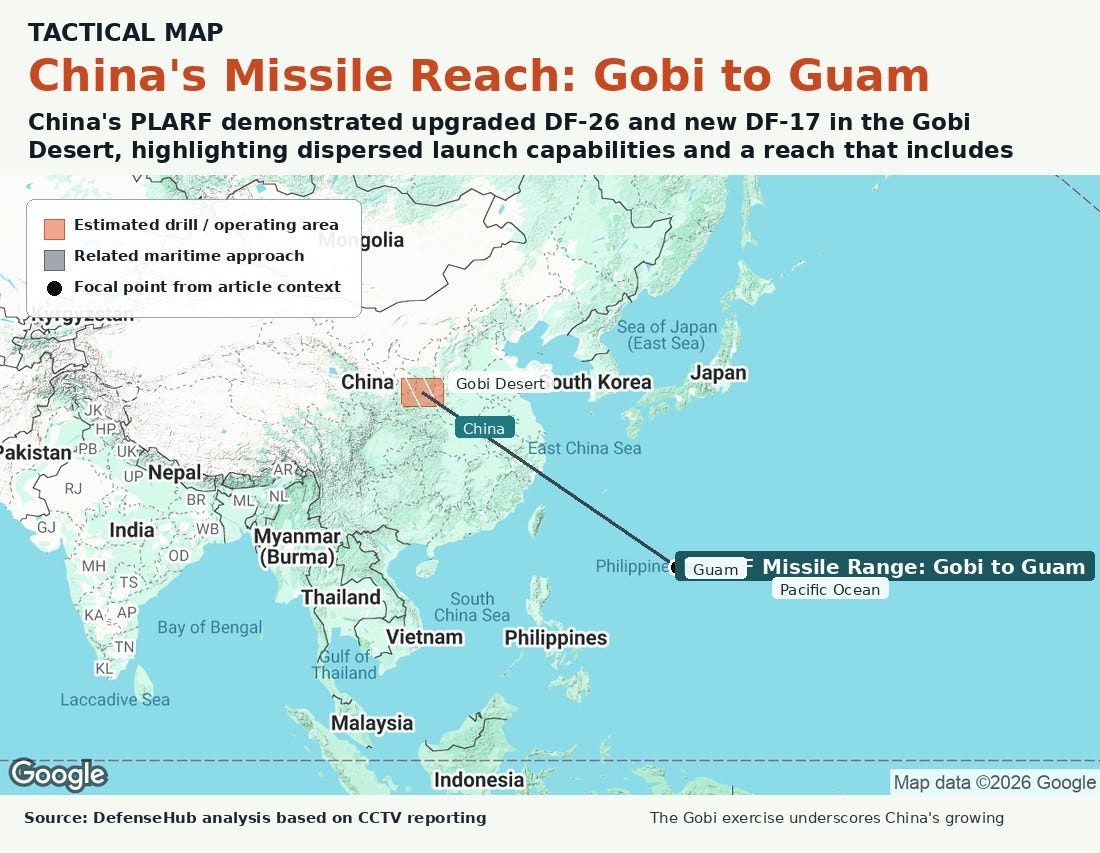
Map is illustrative and intended to orient the operational geography discussed below.
Operational Context
The DF-26 has been publicly known since at least the September 2015 Beijing military parade. The DF-17 has been publicly identified as operationally deployed, making it one of the few hypersonic glide vehicle systems confirmed in service by any military. The U.S. equivalent land-based hypersonic strike program remains in development and testing as of mid-2026. A point worth correcting here: framing this as a land-based symmetry gap understates the actual U.S. strike posture in the Pacific. The United States fields Tomahawk-armed surface ships and submarines throughout the region, and air-delivered standoff weapons from bomber and fighter platforms already hold Chinese territory at risk. The more precise and honest claim is that the U.S. currently lacks ground-launched intermediate-range strike options at scale in the Pacific, a constraint that matters for alliance burden-sharing, basing politics, and targeting flexibility in specific scenarios, but does not mean the U.S. lacks comparable reach or capacity through other delivery modes. The United States withdrew from the Intermediate-Range Nuclear Forces Treaty in 2019. Since then the U.S. has been developing land-based intermediate-range strike options, but none are fielded at scale in the Pacific. That specific gap shapes deterrence planning for U.S. bases in Guam and Japan, particularly around the politics of where ground-launched systems could be hosted and under what conditions allies would accept them. The doctrinal shift toward mobile dispersal follows logic that has been tested in other theaters. Fixed or semi-fixed launch infrastructure is vulnerable to long-range precision strike and reconnaissance-strike combinations. A force that can disperse before an adversary's targeting picture updates creates a harder suppression problem. The joint exercise format reinforces this: PLARF units operating alongside Ground Force and Air Force elements suggests integration of launch authority, air cover, and ground maneuver support. That is more operationally sophisticated than a siloed rocket force posture. The timing of this exercise sits one year ahead of the 2027 window that U.S. Indo-Pacific Command has repeatedly cited publicly as a period of elevated risk in the Taiwan Strait. It is tempting to read the CCTV release as calibrated external messaging aimed at Washington, Tokyo, and Taipei. That reading may be correct. It also may not be. PLARF exercise schedules reflect internal readiness cycles, unit certification requirements, and seasonal training windows that operate on their own logic largely independent of external signaling calendars. This exercise could have been scheduled months ago for purely internal reasons and timed to a CCTV broadcast afterward as a secondary decision. Both explanations are consistent with the available evidence, and readers should hold them in parallel rather than defaulting to the more dramatic interpretation.
🇨🇳 OSINT Radar — Direct Translation from China:
"China unveiled an upgraded DF-26 missile in 2022. The missile has extended range and advanced capabilities. It is part of China's efforts to modernize its military...."
My Read
This exercise may be calibrated external messaging. It may also be a routine training milestone that received CCTV coverage as a secondary decision. The honest position is that a single broadcast cannot distinguish between those two explanations, and this analysis should not pretend otherwise. What the post's own caveat in the next section effectively concedes is worth stating plainly here: the core argument that PLARF has genuinely shifted to dispersed autonomous launch operations rests almost entirely on one publicized exercise. That is a thin evidentiary base. A skeptical analyst would note, correctly, that one daylight exercise under favorable conditions proves nothing about sustained field posture, night operation capability, adverse weather performance, or multi-unit salvo coordination. The claims in this post are flags for continued monitoring, not confident conclusions about a doctrinal transformation. The part that deserves analytical attention is the fixed-site reduction claim, but it deserves that attention with the full weight of its complications included, not buried. Mobile dispersal is not a straightforward net gain. Spreading PLARF units across the Gobi in smaller independent formations makes them harder to target in the opening hours of a conflict. It also makes them harder to coordinate, harder to issue authenticated launch orders to, and harder to protect from accidents or unauthorized actions. Those command-and-control vulnerabilities are not minor footnotes. In the DF-26 scenario specifically, where a single missile can carry either a conventional or nuclear warhead and adversary decision-makers cannot tell which, degraded coordination under dispersal creates genuine escalation risks that Beijing would have to weigh carefully. A dispersed force that launches ambiguous warheads in a less coordinated salvo pattern, under communication stress, in a crisis that has already escalated to strikes, is a force that introduces uncertainty on both sides simultaneously. That does not make dispersal irrational, but it limits how far it can practically go before the command-and-control costs outweigh the survivability benefits. The exercise shows Beijing advertising the capability. It does not show Beijing having solved the problem. The defense-penetration claims for both systems warrant real skepticism. China's defense industry has a consistent track record of announcing capability improvements that take years to reach actual operational performance. CCTV claims are not a technical manual. The exercise footage shows a daylight launch under presumably favorable conditions. Night operations, adverse weather performance, and multi-unit simultaneous salvos would be far more informative indicators of actual automation maturity. What would change this assessment is commercial satellite imagery showing PLARF units maintaining dispersed field positions for extended periods outside of exercise windows. Sustained posture change is structurally different from an exercise demonstration, and that distinction matters for how seriously alliance planners should be revising their assumptions right now versus flagging this for continued monitoring.
What to Watch
Commercial satellite operators should be monitored for imagery of PLARF garrisons in Qinghai, Xinjiang, and Henan provinces showing changes in vehicle counts or dispersal patterns in the weeks following this exercise.
Sustained dispersal outside of exercise windows would distinguish genuine posture change from theater.
U.S. Space Command and Indo-Pacific Command public statements on missile defense readiness in the Western Pacific will signal how seriously the Pentagon is treating the DF-17 configuration update.
Procurement announcements from Japan's Ministry of Defense regarding extended-range surface-to-air missile batteries or the timeline for deploying land-attack cruise missiles to Ground Self-Defense Force units will indicate whether Tokyo is adjusting its deterrent posture in response.
South Korean or Australian government statements about updating bilateral missile defense cooperation frameworks would indicate alliance-level concern about the DF-26 range envelope and its implications for the Second Island Chain.
Recommended Sources
U.S. Department of Defense Annual Report on Military and Security Developments Involving the People's Republic of China: The authoritative unclassified U.S. government baseline for PLARF force size, doctrine, and capability assessments, updated annually. This is the primary source for any claims about PLARF missile inventories and system status.
CSIS Missile Defense Project (Missile Threat database): Maintains open-source technical profiles on the DF-26 and DF-17 with range estimates, warhead options, and operational status, drawn from declassified and open-source intelligence. Useful for grounding specific system specifications in sourced data rather than broadcast claims.
Janes: The professional intelligence standard for confirmed PLARF order of battle, missile system specifications, and proliferation-linked data. Subscription required, but the most reliable open-access alternative for verified technical details on Chinese missile programs.
RAND Corporation: Has published foundational analysis on PLARF targeting doctrine and anti-access and area-denial strategy. Essential background for understanding how mobile launch dispersal fits China's broader campaign theory and what it means for U.S. basing in the Western Pacific.
The War Zone (The Drive): Provides consistent, technically grounded open-source coverage of PLA exercise footage and commercial satellite imagery analysis. Useful for tracking real-time PLARF posture changes that follow events like this exercise.
Sources & Methodology
This briefing is based on open-source reporting, official releases, procurement documents, defense-industry disclosures, and specialist analysis available at publication time. Claims involving battlefield effects, classified programs, or active operations are treated cautiously unless corroborated by multiple independent sources.
DefenseHub prioritizes primary sources where available, including official releases, budget and procurement records, legislative documents, technical disclosures, institutional research, and reputable reporting.
Corrections or source clarifications can be sent through the DefenseHub contact page.
— R. Planche · DefenseHub