

Blitzkrieg: How Speed, Sequence, and Surprise Broke the Line
Tactics | Blitzkrieg is often treated as shorthand for "fast war," but the tactic it describes was a specific, sequenced system, not a single overwhelming weapon
DefenseHub · Saturday — Tactics · July 11, 2026
By R. Planche · Chief Editor & OSINT Curator
Blitzkrieg is often treated as shorthand for "fast war," but the tactic it describes was a specific, sequenced system, not a single overwhelming weapon. Armor broke the line, air strikes disoriented the defenders before they could reorganize, and infantry then poured through the gap to keep the front changing faster than command structures could track it. Pacific Atrocities Education's breakdown of World War 2 tactics lays out how that three-step process actually functioned, and what follows also includes our own interpretation of what that sequencing meant for how fast-moving doctrine can outpace fixed-position defense more broadly, not just the source's own claims.
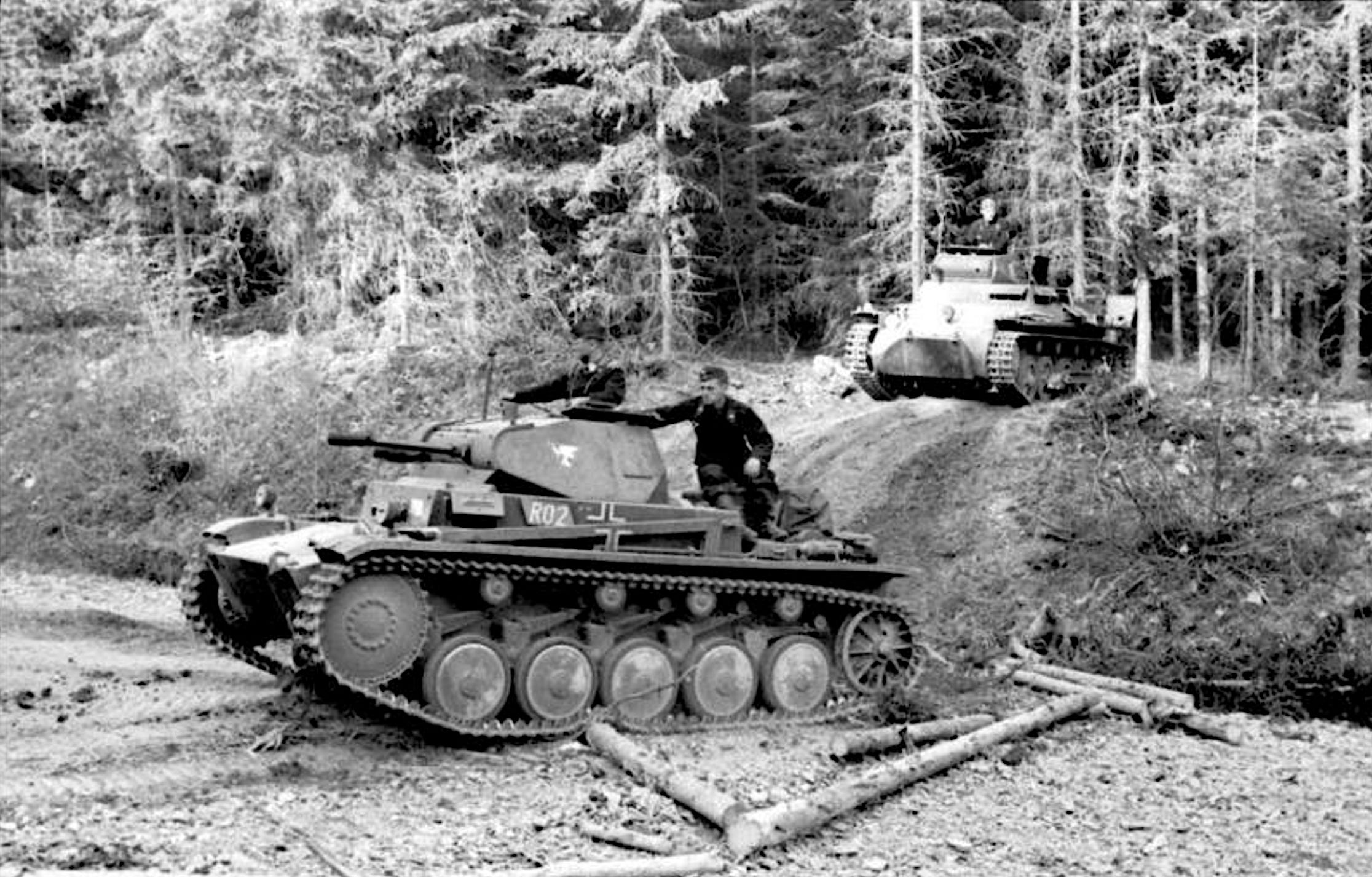
📸 Photo by Bundesarchiv Bild 101I-382-0248-33A, Im Westen, Panzer II
What We Know
Blitzkrieg was not a single weapon. It was a sequence. According to Pacific Atrocities Education, the tactic worked as "a coordinated, maneuver-focused military tactic in which the objective was to break enemy lines as quickly as possible through a dense concentration of armored vehicles, air strikes, and then eventually the infiltration of ground troops." The process ran in three phases. First, armored and motorized columns punched through weak points with short, powerful thrusts rather than a broad front.
Second, air strikes hit before defenders could reorganize, described in the source as relying "on the element of surprise via air strike." Third, ground troops flooded into the gap, confusing the defense and making it, in the source's words, "more difficult for them to respond to the continuously changing battlefronts." That sequencing is the core of what made the tactic effective against a fixed-position defense: speed and compounding disruption across three phases, rather than brute force in any single one.
The source frames the goal of that sequence as Vernichtungsschlacht, total annihilation through unilateral victory rather than negotiated collapse. The same source also documents how other WW2 theaters tested variations of speed versus static defense. Admiral Karl Donitz's wolf pack submarine tactic used 8 to 20 U-boats coordinated by a "shadower" vessel that stayed hidden until enough boats converged on an Allied convoy, then attacked from multiple directions at once. It was a naval echo of the same principle: concentrate force, strike where the enemy cannot mass a response fast enough.
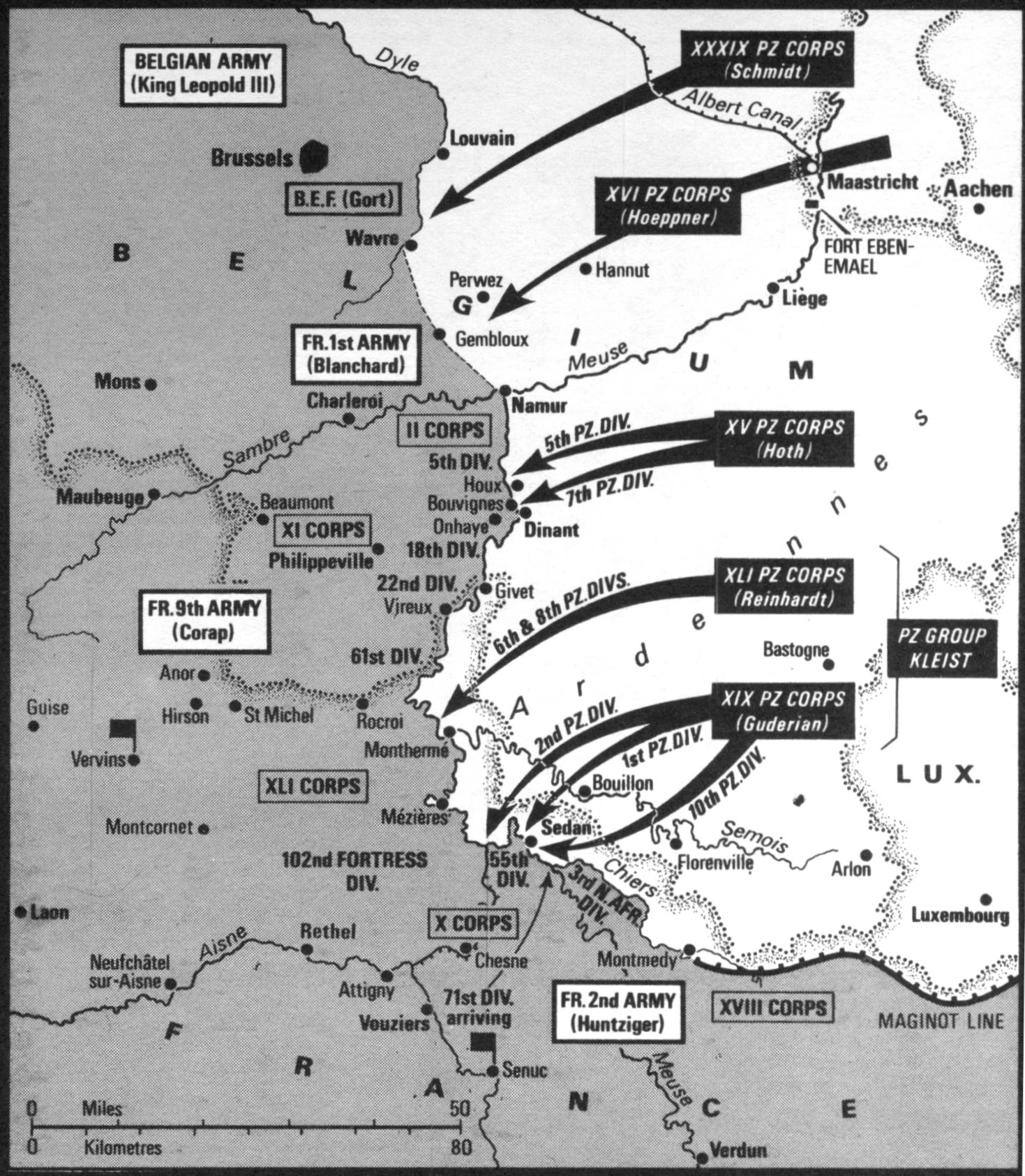
📸 German Panzer Corps Outflank the Allied Defenses - Battle of France: May 12-13, 1940 - A surprise German armored attack through the weakly defended Ardennes triggered a severe crisis for the Allied forces. - Source: https://onwar.com
By contrast, the Battle of Okinawa shows the doctrine's limit. Per the TAMUCC (Texas A&M University-Corpus Christi) source, Japanese forces abandoned speed altogether, taking "a defensive position" built around tunnels and terrain to slow the American advance, while US forces answered with "a massive artillery barrage followed by a sweeping maneuver," the mirror image of blitzkrieg's speed logic applied by the attacker instead of the defender.
Operational Context
The dossier used for this piece describes how the three-step tactic functioned mechanically, but it does not document how quickly or effectively any specific defending force actually attempted to respond to it in real time, or how much of any battlefield outcome came down to communication breakdowns between units versus the tactic itself simply outrunning available responses. That is a real gap, and readers should treat the balance between doctrinal surprise and command failure as an open question rather than something this piece can resolve. The wolf pack tactic applied a related pressure at sea.
Coordinated, delayed-attack U-boat groups were, in the source's description, "difficult for the Allied forces to respond to, due to the sheer number of submarines, the spontaneous attacks coming from various directions," a naval version of the same asymmetry: concentrated surprise against dispersed defense. The limit of the comparison matters too. The source's own material shows the tactic did not translate cleanly across every theater. At Okinawa, distance, logistics, and fortified terrain pushed Japan into a defensive attrition model instead of a fast-maneuver one, and pushed the United States toward firepower-heavy offensives rather than maneuver shock.
That contrast, within the same dossier, is itself evidence that speed-based tactics depend heavily on terrain and position, not just doctrine.
My Read
My read, and this is interpretation rather than something the source itself states, is that the real innovation in the three-step sequence was not any single component. It was the tempo created by combining them. Armor, air power, and infantry infiltration were each pieces that existed before blitzkrieg as a named doctrine. What the sequence did was link them into one continuous tempo, fast enough that a defender organized around holding a fixed line had to react to three compounding disruptions at once rather than one.
I would flag a caveat on my own reasoning here. Any broader claim about what this implies for modern doctrine, alliance planning, or "reaction speed" as a general principle is my extrapolation, not a conclusion the Pacific Atrocities Education source draws or supports with evidence. It is a single blog-level source on WW2 tactics, not a military history authority, and it should not be read as backing claims about modern deterrence theory or alliance credibility. Treat that connection as speculative framing on my part, worth debating, not established fact.
The best counter-argument sits inside the dossier itself: Okinawa. Japanese forces there deliberately rejected the speed-and-maneuver logic and still forced a costly, prolonged fight through terrain and fixed defense. That shows the tempo advantage behind fast-maneuver tactics is not universal. It depends on the attacker having room to maneuver and a defender unable to trade space for time. I would not treat the three-step sequence as a timeless formula that works regardless of terrain or position.
What would change this assessment is more direct evidence on how specific defending forces actually attempted to respond to a fast-tempo, three-phase attack in real time, since the dossier describes the tactic's mechanics but not the defender's side of that clock.
What to Watch
Watch whether further sourcing clarifies how defending commands historically attempted to respond to fast, sequenced armor-air-infantry attacks, and how much of any collapse was doctrinal surprise versus communication failure between units.
Watch how modern militaries citing "blitzkrieg-inspired" doctrine, particularly in combined-arms training exercises, actually sequence armor, air, and infantry compared to the historical three-step model described here.
Watch convoy and air-defense logistics in active conflicts for wolf-pack-style saturation tactics, where adversaries deliberately mass strikes to overwhelm finite interceptor or escort stockpiles.
Watch whether island or urban warfare doctrine continues trending toward Okinawa-style defensive attrition rather than fast-maneuver tactics, especially in terrain that limits an attacker's room to maneuver.
Recommended Sources
The Four Fronts of World War 2 Military Tactics: Pacific Atrocities Education's breakdown of blitzkrieg, wolf pack tactics, kamikaze, and cryptography as the four defining WW2 tactical fronts.
Japanese Strategy in the Second Phase of the Pacific War: Japan's National Institute for Defense Studies documents Army-Navy information gaps and the "Pine Transport" resupply program during the Pacific War.
Military Tactics in the Battle of Okinawa: Texas A&M University-Corpus Christi's comparison of Japanese defensive tunnel warfare versus American offensive maneuver at Okinawa.
Sources & Methodology
This briefing is based on open-source reporting, official releases, procurement documents, defense-industry disclosures, and specialist analysis available at publication time. Claims involving battlefield effects, classified programs, or active operations are treated cautiously unless corroborated by multiple independent sources.
DefenseHub prioritizes primary sources where available, including official releases, budget and procurement records, legislative documents, technical disclosures, institutional research, and reputable reporting.
Corrections or source clarifications can be sent through the DefenseHub contact page.
— R. Planche · DefenseHub