

AWS Built a Classified Cloud for Select Contractors. Northrop Is the First Test Case
Intelligence | New cloud infrastructure promises to accelerate classified program development, but raises questions about industry-intelligence integration
DefenseHub · Friday — Intelligence · July 3, 2026
By R. Planche · Chief Editor & OSINT Curator
According to Defense One, AWS has launched a secret cloud environment built specifically for classified defense industry workloads. The reporting is based on statements AWS and Northrop Grumman executives made during a press call announcing the launch, not on an independent audit or a published accreditation document. Northrop Grumman is the first company confirmed to be moving programs onto it. The offering promises to speed up development of sensitive programs, but right now the evidence of real scale rests on one named customer describing one deployment.
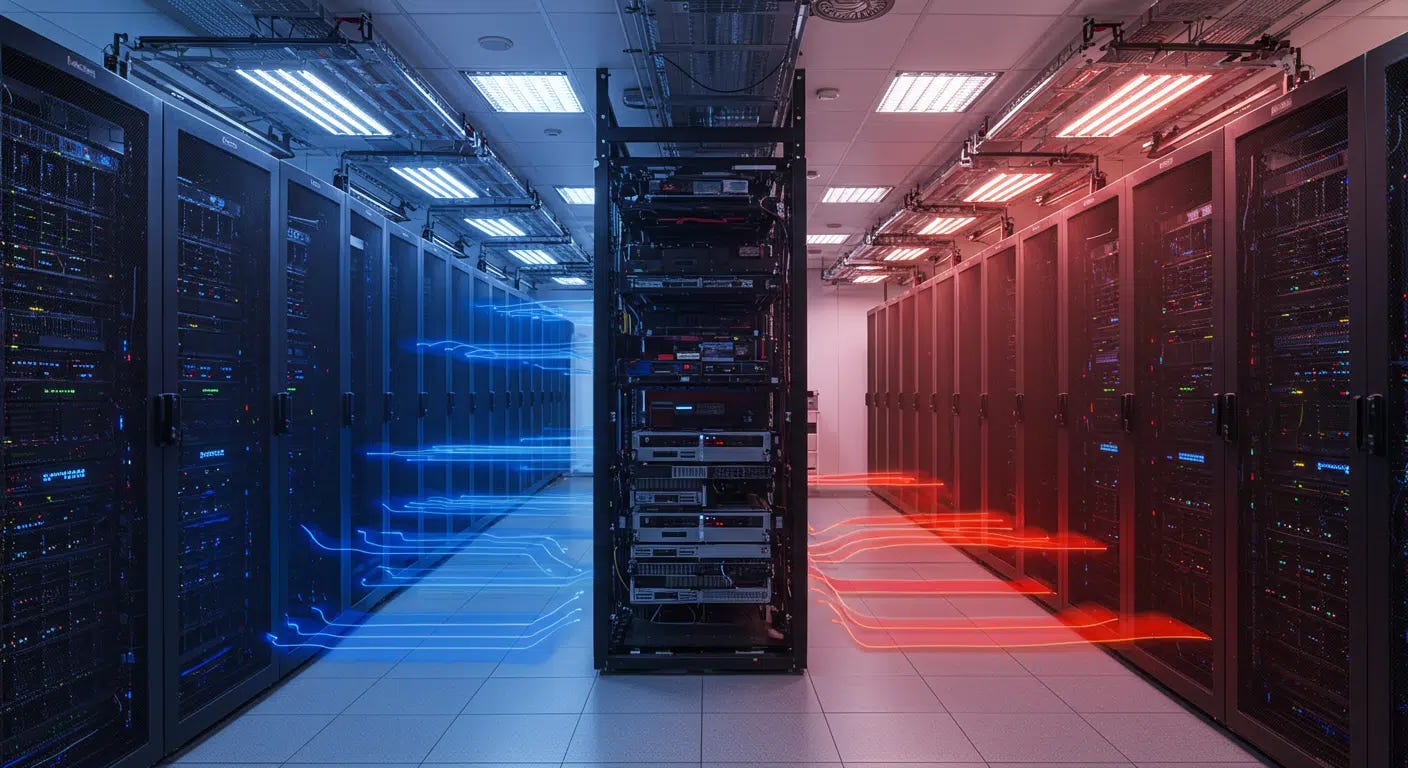
📸 Illustrative data center cages
What We Know
Northrop Grumman is the confirmed anchor customer. Drew Barnes, the company's vice president of IT infrastructure and operations, said migrating classified programs to AWS Secret Cloud for Industry "fundamentally changes how we develop and scale sensitive programs at speed." That line comes from a real customer rather than a vendor spokesperson, which gives it more weight than pure marketing copy. But it is still one company's characterization of its own experience, offered with no performance metric, timeline, or cost figure attached.
It should be read as a claim to watch, not evidence that the platform has already changed program outcomes. It is also worth asking why Northrop Grumman moved first. The company already runs extensive workloads on AWS government cloud infrastructure, and contract or pricing incentives tied to that relationship could explain early adoption as easily as any technical advantage in the new offering. The available reporting does not say which factor drove the decision, and that gap matters when judging how quickly other primes might follow.
AWS's Dave Levy, on the same press call, credited the Defense Information Systems Agency and the Defense Counterintelligence and Security Agency with partnering on what he called a yearslong effort. DISA runs the Pentagon's core networks and sets cloud security standards. DCSA vets facility clearances and industrial security for contractors. If those two agencies formally signed off on this architecture, that would matter more than the press release itself. What is actually confirmed is Levy's characterization of the partnership on a call, not a published joint accreditation standard or documentation from either agency.
This launch sits on top of an already dominant AWS footprint in government. The company runs multiple top secret cloud regions, having opened its first in 2017. It holds the intelligence community's C2E contract, the Pentagon's Joint Warfighting Cloud Capability contract, and the NSA's "Wild and Stormy" contract. Nearly every US federal agency, plus roughly 15,000 government agencies worldwide, already uses AWS in some capacity, per the company's own figures. There is also a financial pattern behind this launch.
Cloud credit and discount programs let federal customers draw down pre-negotiated AWS spending instead of running fresh procurement each time, which is what makes rapid, wide adoption across agencies possible. Last August, AWS discounted $1 billion of software for federal customers through its GSA OneGov arrangement, running through December 2028.
This week, AWS announced up to $1 billion more in cloud credits for the 18 agencies of the intelligence community, through October 2030, which Levy described as "like GSA OneGov, but for the IC." That gives AWS two parallel billion-dollar spending pipelines already in motion, one aimed at the defense industrial base and one at the intelligence community, both running through a single commercial provider.
Operational Context
Classified collaboration between government and contractors has historically run through physically separated, agency-specific enclaves and government-owned secure facilities. Sharing data across primes required bespoke accreditation for each connection, which is slow by design and one reason large classified programs have long struggled with delivery timelines. This move extends a pattern already established inside government cloud contracting, where AWS's C2E and JWCC awards consolidated classified processing under a small number of commercial providers. What is new is pushing that same model outward to industry itself, not just government agencies. The comparison only goes so far, though.
Under C2E and JWCC, the government retains full authority over classification boundaries within its own systems. A shared classified cloud spanning multiple defense primes raises a different question: how is one contractor's classified intellectual property segregated from a competitor's on the same commercial infrastructure. That detail is not addressed in the available reporting, and it is the kind of question that should not be waved through on the strength of a press call. DCSA's role as the authority for facility clearances suggests accreditation processes built around physical SCIFs will need updating for cloud-hosted classified environments.
That gap between what the technology promises and what oversight has actually verified is the part of this story most likely to matter later. AWS is simultaneously courting the defense industrial base and the intelligence community with billion-dollar credit programs, which means classification and oversight questions are arriving on two fronts at once, not one.
My Read
This is a real capability with a genuine institutional foundation, not vaporware, but the "launches" framing overstates how far it has actually spread. One prime, Northrop Grumman, is confirmed. That is a meaningful proof point, not a sector-wide shift, and it may say as much about Northrop's existing AWS footprint as about the platform itself. What matters most here is not Drew Barnes's quote. It is the DISA and DCSA partnership Levy described.
If two separate federal security authorities actually signed off on a shared classified cloud for private industry, that would be the real doctrinal change, more consequential than any single customer's testimonial. But that is a claim to verify, not a fact to assume. Nothing in the current reporting confirms a published joint accreditation standard exists, only that Levy said the agencies partnered on the effort. Speed claims are marketing until the accreditation framework behind them is public. The strategic implication cuts both ways.
If this scales, defense contractors could collaborate on classified programs over shared infrastructure instead of building bespoke, siloed networks for every partnership, which genuinely could cut development time and speed intelligence-relevant work across cleared partners. But it also concentrates an enormous share of the defense industrial base's classified data with a single commercial vendor, and concentration is exactly what adversary intelligence services look to exploit. The best counter-argument is that vendor concentration already exists. AWS already runs C2E, JWCC, and NSA infrastructure, so this is incremental, not revolutionary. Fair point.
But moving classified industry-to-industry collaboration onto shared cloud infrastructure is a different category of exposure than government hosting its own systems on AWS servers. What would change my assessment: more primes confirming migration within the next year, and DCSA publishing explicit multi-tenant classified accreditation standards. Until then, this reads as a strong first deployment with an unproven adoption curve, built on one customer's account of one migration.
What to Watch
Watch whether defense primes beyond Northrop Grumman publicly confirm migrating classified programs onto AWS Secret Cloud for Industry within the next 12 months, which would show real sector adoption rather than a single flagship case.
Watch for DCSA or DISA to publish documentation confirming the joint accreditation Levy described on the press call, since none has surfaced yet and its absence leaves the segregation question unanswered.
Watch for DCSA to issue or update multi-tenant classified cloud accreditation guidance within the next 12 to 18 months.
Watch how quickly the 18 intelligence community agencies draw down AWS's $1 billion cloud credit program through October 2030, as slow uptake would suggest the "IC OneGov" framing is ahead of actual demand.
Watch for a GAO or Department of Defense Inspector General review of classification and data segregation practices in shared commercial classified cloud environments, given the scale of AWS's federal footprint.
Recommended Sources
Defense One: original reporting containing the direct quotes from Northrop Grumman and AWS executives on the Secret Cloud for Industry launch.
Defense Information Systems Agency: the Pentagon authority whose partnership with AWS underpins the classified network and security architecture behind this offering.
Defense Counterintelligence and Security Agency: the body responsible for industrial facility clearances, central to any future accreditation standard for cloud-hosted classified work.
Government Accountability Office: the likely source of future oversight findings on cloud vendor concentration and classified data handling across defense contractors.
War on the Rocks: for deeper analysis on defense industrial base modernization and the procurement trends driving cloud consolidation among commercial providers.
Sources & Methodology
This briefing is based on open-source reporting, official releases, procurement documents, defense-industry disclosures, and specialist analysis available at publication time. Claims involving battlefield effects, classified programs, or active operations are treated cautiously unless corroborated by multiple independent sources.
DefenseHub prioritizes primary sources where available, including official releases, budget and procurement records, legislative documents, technical disclosures, institutional research, and reputable reporting.
Corrections or source clarifications can be sent through the DefenseHub contact page.
— R. Planche · DefenseHub